Tuesday, April 16, 2013

Here is the movie we watched today.  I got it from the library.
https://opac.cadl.org/record=b1544334~S15

This is a book I found while I was looking for that movie.  I found the parts I've read so far absolutely fascinating and a few students who had a chance to look at it seemed interested in reading more.  It has lots of footnotes and pictures if you want to do more research and I'll bring it next week in case we have time for anyone to look at it some more.  It can also be found at the library
https://opac.cadl.org/record=b1945117~S15

Tuesday, April 9, 2013

The book we didn't get to today.  It has pictures and explanations of several different kids of castles throughout history. 
You can get it at the CADL.
https://opac.cadl.org/record=b1885261~S15

Tuesday, January 29, 2013

Bayeux Tapestry


Here's the picture we saw in class today.
The entire Bayeux Tapestry
Add caption


Here's the link to where I got the the picture in case you can see it better that way.

http://upload.wikimedia.org/wikipedia/commons/thumb/f/fe/Tapisserie_de_Bayeux_31109.jpg/16324px-Tapisserie_de_Bayeux_31109.jpg

The pictures in the scenes depicted show:
  • 623 people
  • 202 horses
  • 55 dogs
  • 506 other birds and animals (some mythical)
  • 49 trees
  • 41 ships
  • 37 buildings
  • 57 Latin inscriptions containing nearly 2000 letters

    More fun facts about the tapestry can be found here:

     http://www.middle-ages.org.uk/bayeux-tapestry.htm
     

Tuesday, January 15, 2013

Here is the link to the video we watched in class today.

https://www.youtube.com/watch?v=VIJlFBAAjvE

Next week we'll be learning about religion.

The work of budding stonemasons


Wednesday, January 9, 2013

Here is the recipe web site I found last term to use a resource for our end of term pot luck.
http://recipes.medievalcookery.com/

Here's one for adventurous cooks.  It just translates the recipes so you still have to figure out the measurements for yourself.
http://www.godecookery.com/mtrans/mtrans.htm

I'll keep looking for more sources.

Welcome to a new term.  This is the movie we watched this week if anyone wants to show it to their families and/or friends.  I got it through CADL or you can watch it online here: http://video.pbs.org/video/1619317222/


NOVA: Building the Great Cathedrals DVD - shopPBS.org

Monday, November 19, 2012


Sellenger's Round or The Beginning of the World

Original instructions Facsimile of John Playford's The English Dancing Master 3rd Edition 1657

(Hopefully) easier to understand instructions:

As many couples as want to dance stand in a circle with the woman to the right and the man to the left of each couple.

Part I
A   Everyone holds hands and takes eight sliding steps to the left. Repeat to the right

B1 Everyone takes four steps forward to the center of the circle, then four steps back to their places.
      Face your partner, take a step to the right, then a step to the left, then turn around.

B2 Repeat B1.

Part II
A While holding hands, everyone takes four steps forward to the center of the circle, then four steps back to their                places.   Repeat.

BB Repeat B1 and B 2 from Part I.

Part III
A Partners face each other, take four steps toward each other until they are lined up right shoulder to right shoulder, then take four steps back to their place.
Partners face each other, take four steps toward each other until they are lined up left shoulder to left shoulder, then take four steps back to their place.

BB Repeat B1 and B 2 from Part I.

Part IV
A Partners hold right hands and walk eight steps around each other. Partners hold left hands and walk eight steps around each other.

BB Repeat B1 and B 2 from Part I.


Tuesday, November 6, 2012

Here are more links for more information on some of the other stuff we talked about today.


http://www.leeches.biz/leech-help.htm

http://news.nationalgeographic.com/news/2003/10/1024_031024_maggotmedicine.html

http://en.wikipedia.org/wiki/Witch-hunt
These are the sources I used for the first part of today's class.

http://www.chm.bris.ac.uk/webprojects2002/crabb/history.html

http://www.chm.bris.ac.uk/webprojects2002/crabb/history.html

http://en.wikipedia.org/wiki/Nicolas_Flamel

http://www.alchemylab.com/flamel.htm

The last one has links to some of the things Nicholas Flamel wrote if you want to try some alchemy of your own.  I didn't get most of it, but you might do better and some of the pictures are pretty.

Tuesday, October 30, 2012

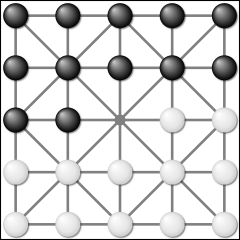
Alquerques -- became Draughts when Europeans tried to play it on a Chess board --  then became Checkers

Each player has 12 pieces.  They start on the two back tows and the two far right places of the third row.  Only the center space will be open when the game starts.

Pieces can move one space in any direction.

A player captures pieces by jumping them like in modern checkers.

If a capture or captures are possible, they must be taken.

If a player does not take a possible capture, the other player may remove that piece before starting their turn.

You win by taking all your opponents pieces or by trapping them where they cannot move.


Medieval vs. Modern Chess

Pawns only moved one space forward -- no first move of two spaces and no capture on the diagonal, they became queens if they reached the other side.

Bishops moves two spaces diagonally and could jump over another piece to make their move.

The Queen moved one space diagonally.

Rooks, Knights, and the King moved the same as they do now.

Like modern chess, you win by capturing or blocking the King.  You could also win (though it was considered a lesser victory) by taking all of your opponents pieces except his King.


Tuesday, October 16, 2012

Next week we will be learning games.  If it is not raining, we will spend most of the class outside.  Please dress comfortably for the temperature.  If it is raining, we'll go outside the week after next.


Some students personal heraldry